Chapter 11
The Birth of the World Wide Web
Although the Internet had already existed for some decades in the form of the ARPANET and other networks based on the TCP/IP protocol, it was the invention of the World Wide Web (WWW) in the early 1990s that made it accessible and attractive to a mass audience. The Web transformed the Internet from a network used primarily by researchers and technicians to a global platform for information sharing, communication, and commerce.
11.1 The Origins at CERN:
An Idea for Sharing Knowledge
The idea of the World Wide Web was born in the laboratories of CERN (Conseil Européen pour la Recherche Nucléaire) in Geneva at the end of the 1980s. Tim Berners-Lee , a British computer scientist working at CERN, proposed a system to allow researchers around the world to easily share information and documents linked to each other via hypertexts .
Berners-Lee identified the need for a system that would overcome the barriers between different IT platforms and document formats, creating a universal and interconnected information space. Between 1989 and 1991, Berners-Lee developed the three fundamental elements that make up the World Wide Web:
- HTML (HyperText Markup Language): A markup language that allows you to structure and format documents (web pages) using tags and attributes. The distinctive feature of HTML is the ability to create hyperlinks , which allow users to easily navigate from one page to another with a simple click.
- HTTP (HyperText Transfer Protocol): A communications protocol that defines how messages are formatted and transmitted between a client (the web browser) and a server (the web server that hosts the pages). HTTP is the protocol on which the exchange of information on the Web is based.
- URL (Uniform Resource Locator): A standard addressing system that allows each resource (web page, image, video, etc.) present on the Web to be uniquely identified. A URL specifies the protocol to be used (usually HTTP), the name of the server and the path of the resource on the server.
In December 1990, Berners-Lee created the world's first web server on his NeXT computer and wrote the first web browser, initially called WorldWideWeb (later renamed Nexus to avoid confusion with the very concept of the Web). The first web page described the design of the World Wide Web itself.
11.2 Initial Diffusion and the First Browsers:
Access Becomes Graphical
In the early 1990s, the Web remained primarily a tool used by the scientific and academic community. However, its potential for information sharing was evident. A fundamental step towards its diffusion to a wider audience was the development of more user-friendly web browsers with graphical interfaces.
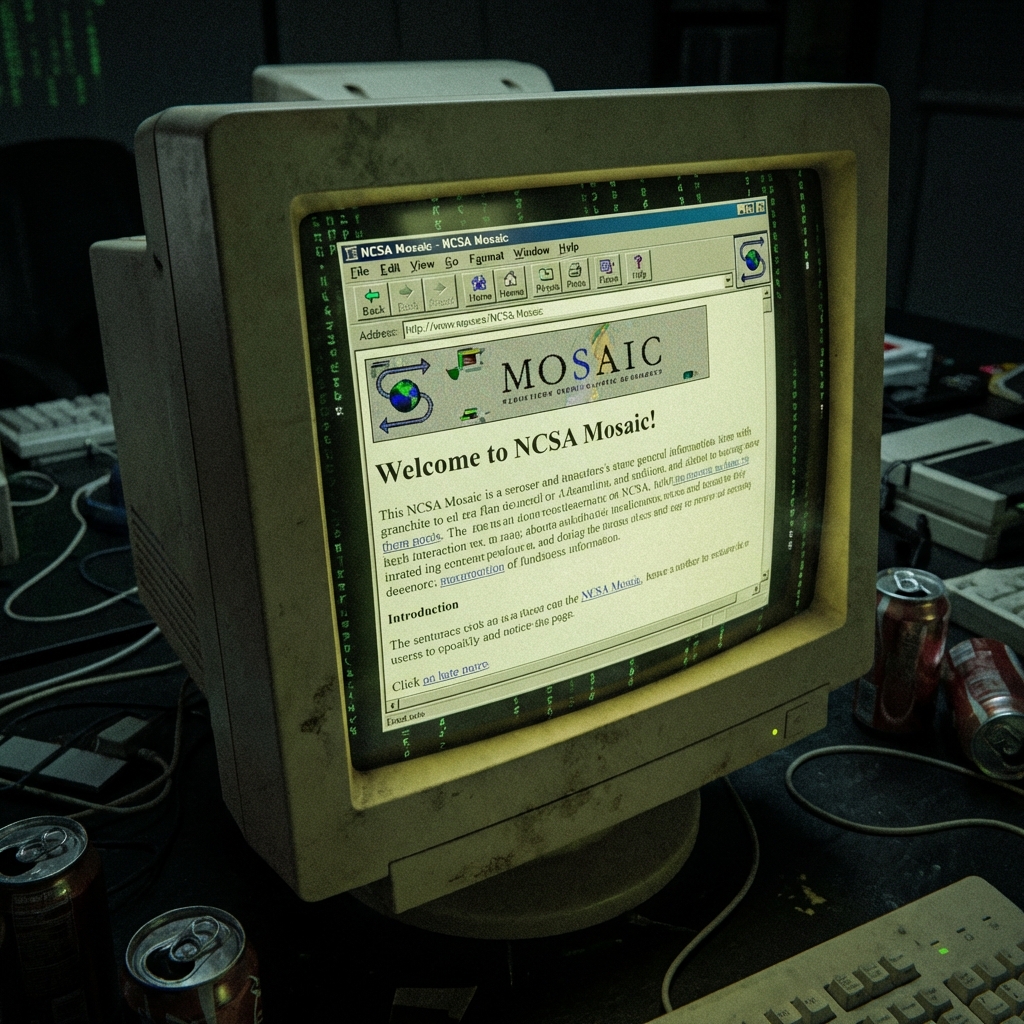
In 1993, a team led by Marc Andreessen and Eric Bina at the NCSA (National Center for Supercomputing Applications) at the University of Illinois developed Mosaic . Mosaic was the first widely popular web browser with an intuitive graphical user interface, which allowed you to view not only text but also images within web pages.
Mosaic's ease of use made the Web much more accessible to people without advanced technical skills and contributed significantly to its rapid growth.
Mosaic was released for free and quickly became the reference browser for many users, both on Unix systems and on Macintosh and Windows. Its simple interface and ability to display multimedia elements opened up new possibilities for web content creation and online user experience.
11.3 The Birth of the Commercial Era of the Web:
The Internet Opens Up to the World
Another crucial event for the explosion of the Web was the privatization of the Internet backbone in the mid-1990s. Previously, the Internet had been financed mainly by public funds and its commercial use was limited. Privatization allowed private companies to build and operate network infrastructure, paving the way for a rapid increase in Internet capacity and availability.
This change, combined with the growing popularity of web browsers such as Mosaic, led to the birth of the commercial era of the Web . Businesses of all types began creating websites to promote their products and services, provide information to customers, and even sell online. The first e-commerce sites began to appear, although secure online transactions were still a challenge.
11.4 The Browser Wars:
Netscape vs. Internet Explorer
The success of Mosaic led to the founding of Netscape Communications Corporation by Marc Andreessen and James Clark. In 1994, Netscape launched Netscape Navigator , a commercial web browser that quickly surpassed Mosaic in popularity due to its advanced features and greater stability. Netscape Navigator became the dominant browser by the mid-1990s.
However, its position was soon challenged by Microsoft , which entered the web browser market with Internet Explorer in 1995, integrated into its Windows operating system. Thus began the so-called " browser wars", a period of intense competition between Netscape and Microsoft that led to rapid innovation in web browser features, such as support for new web standards, multimedia plug-ins, and security features. By the late 1990s, Internet Explorer had captured most of the market share.
11.5 The Explosion of Web Content:
A Universe of Online Information
With the increasing ease of access to the Web and the availability of tools for creating web pages (even if initially rudimentary), the number of websites grew exponentially. The Web quickly became a global repository of information on almost every topic imaginable.
Early websites were often simple static pages with text and images. However, with the introduction of technologies such as the scripting language JavaScript and Cascading Style Sheets (CSS) , websites became more interactive and visually appealing.
The first search engines emerged (such as AltaVista, Yahoo!, and Google, the latter towards the end of the decade) to help users navigate the immense amount of content online. Web portals, such as Yahoo!, offered a wide range of services, including news, email, web directories, and more.
11.6 The Impact of the Web:
A Radical Change
The impact of the World Wide Web on society was profound and multifaceted:
- Access to information: The Web made information accessible to anyone with an Internet connection, democratizing access to knowledge and learning.
- Communication: The Web provided new ways to communicate, complementary to email, through online forums, chat rooms, and later, social media.
- Education: The Web became an invaluable resource for education at all levels, offering access to educational materials, online courses, and learning communities.
- Entertainment: The Web became a platform for entertainment, with news sites, videos, music, and online games.
- Commerce: The Web opened up new opportunities for electronic commerce, allowing businesses to reach customers around the world and consumers to purchase goods and services online.
The emergence of the Web also had important social and cultural implications, influencing the way people interacted, informed themselves and formed their opinions.
The birth of the World Wide Web in the early 1990s represented a fundamental turning point in the history of computing and human communication. Tim Berners-Lee's invention of key technologies such as HTML, HTTP, and URL, followed by the creation of user-friendly web browsers such as Mosaic and Netscape Navigator, made the Internet accessible to a mass audience. Open trade and the subsequent "browser wars" led to rapid growth in the content and functionality of the Web. The Web's impact on information access, communication, education, entertainment, and commerce has been transformative and continues to shape our world.