Chapter 2
The Hardware of the First Computers (1950-1960)
The decade between 1950 and 1960 marked the transition from theory to practice, with the construction and marketing of the first electronic computers. These pioneering machines, despite being enormous and with limited computing capabilities compared to today's standards, represented an epochal technological leap. In this chapter, we will explore the main hardware technologies that characterized this early phase, from vacuum tubes to early memory systems and input/output devices.
2.1 Thermionic Valves:
The Electronic Heart of the First Computers
Early electronic computers, such as the ENIAC (Electronic Numerical Integrator and Computer), used vacuum tubes (or vacuum tubes) as key electronic components for processing and storing information. A vacuum tube is a vacuum electronic device containing a heated filament (cathode) that emits electrons. These electrons are attracted to a positively charged electrode (anode), and the flow of electrons can be controlled by a grid placed between the cathode and the anode.
Vacuum tubes could perform several crucial functions in computer electronic circuits:
- Switches: Used to implement the fundamental logical operations (AND, OR, NOT) necessary for digital processing. The presence or absence of voltage on the grid could control the flow of current between the cathode and anode, acting like an electronic switch.
- Amplifiers: Capable of increasing the amplitude of an electrical signal, an essential function for maintaining the integrity of signals within complex computer circuits.
The use of thermionic valves allowed significantly higher calculation speeds to be achieved compared to previous relay-based electromechanical calculators. However, this technology also had several significant limitations:
- Size and weight: Valves were physically bulky, and a computer like the ENIAC, which contained approximately 18,000 valves, took up an entire room and weighed several tons.
- Power consumption: The valves required a significant amount of electrical energy to heat the filament, generating large amounts of heat. The ENIAC, for example, consumed around 150 kW of power.
- Reliability: The valves were fragile and had a limited lifespan. The failure of a single valve could shut down the entire system, and early computers were prone to frequent malfunctions. Replacing the valves was a complex and time-consuming operation.
- Cost: The production and use of large numbers of tubes made early computers extremely expensive.
Despite these limitations, vacuum tubes represented the dominant technology for the construction of electronic computers during the 1940s and 1950s, opening the way to new possibilities in the field of automatic computing.
2.2 The First Memory Systems:
From Electronic to Magnetic Storage
The ability to store information (both data and instructions) quickly and reliably was a fundamental requirement for computers to function. In the early years of computing, several technologies were developed for creating memory:
- Williams Tubes: Developed at the University of Manchester by Freddie Williams and Tom Kilburn, Williams Tubes were one of the first forms of random access memory (RAM). They were based on the use of a cathode ray tube (CRT), similar to those used in older televisions. The information was stored as an electrostatic charge on the surface of the tube. An electron beam was used to write ("deposit") or read ("detect") the charge. The presence or absence of charge at a specific point represented a bit of information. Williams tubes offered relatively fast access times for the time, but had limited capacity (typically a few hundred bits) and charge tended to dissipate quickly, requiring periodic "refreshing".
- Magnetic Drum Memory: Another early and widely used memory technology was magnetic drum memory. This consisted of a rotating metal cylinder coated with a ferromagnetic material.
Information was recorded and read by fixed magnetic heads positioned near the surface of the drum. Each circular track on the drum could store a sequence of bits. To access specific information, you had to wait for the correct part of the drum to rotate until it reached the read/write head. Magnetic drum memories offered greater capacity than Williams tubes (up to tens of thousands of bits), but had significantly slower access times due to the need to wait for the drum to mechanically rotate. They were used as main memory or secondary (mass) memory in early computers.
- Mercury Delay Lines: Used in the EDVAC and other early computers, mercury delay lines stored data as sound pulses that propagated through a tube filled with mercury. A transducer at one end of the tube converted the electrical pulses into sound waves, which traveled through the mercury and were converted back to electrical pulses at the other end. The speed of sound propagation in mercury determined the delay time, and the data could be "recirculated" through the tube for storage. Mercury delay lines offered greater capacity than Williams tubes, but were sensitive to temperature changes and had sequential access times.
- Ferrite Core Memory (Magnetic-Core Memory): Towards the end of the 1950s, a more reliable and high-performance memory technology emerged: ferrite core memory. This consisted of a grid of small rings (cores) of ferromagnetic material. Each nucleus could be magnetized in two opposite directions, representing the binary values 0 and 1.
The nuclei were crossed by conductive wires that allowed the state of magnetization to be written and read. Ferrite core memory offered faster access times and greater reliability than previous technologies, and became the dominant primary memory technology for computers in the 1960s and 1970s.
2.3 The Architecture of the First Mainframes:
ENIAC and UNIVAC I
Early electronic computers were often enormous machines, designed for scientific and military computing tasks. Two emblematic examples of this era are the ENIAC and the UNIVAC I:
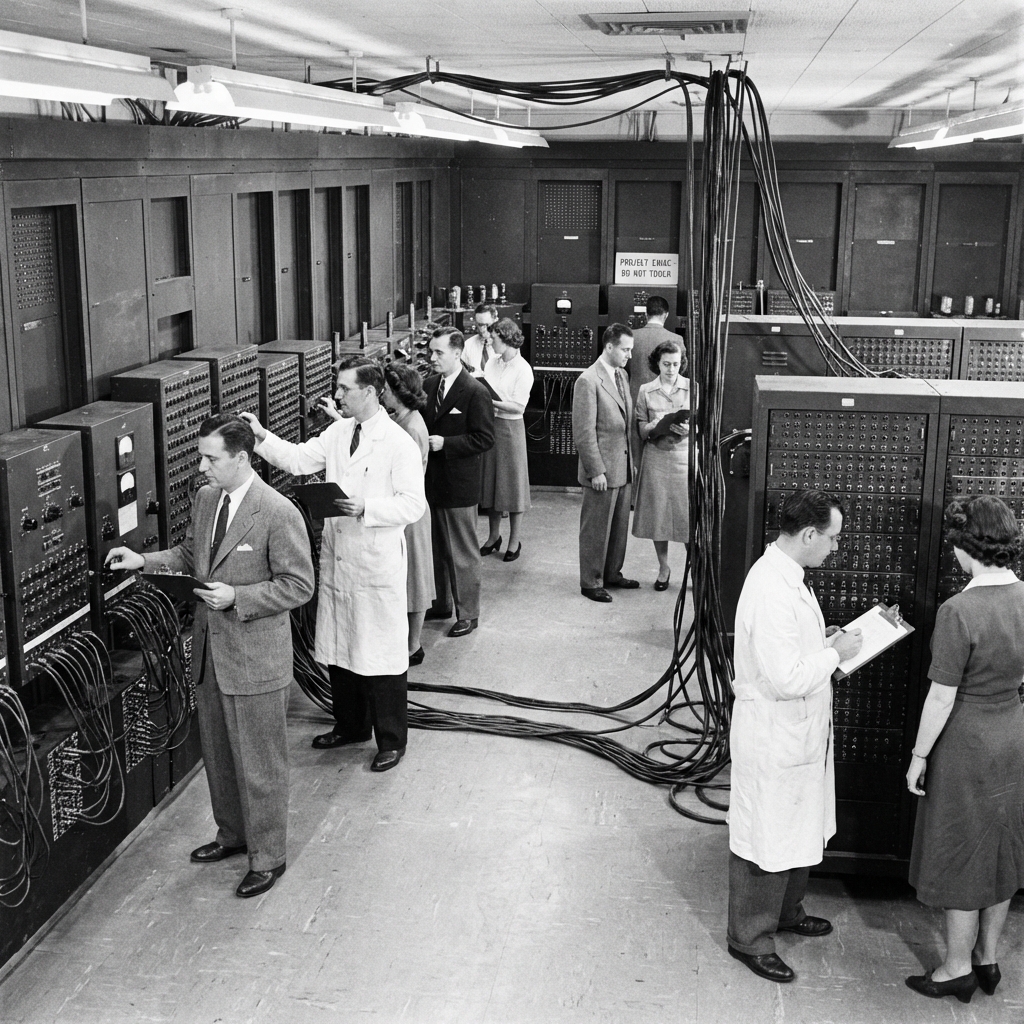
- ENIAC (Electronic Numerical Integrator and Computer): Built at the University of Pennsylvania between 1943 and 1945, the ENIAC is often considered the first general-purpose electronic computer. It was designed primarily to calculate firing tables for US Army artillery. The ENIAC used nearly 18,000 vacuum tubes and occupied an area of approximately 167 square meters. Its programming was a manual and complex process that required the physical reconfiguration of connections via cables and switches. Despite its limitations, the ENIAC demonstrated the potential of electronic computing and was able to perform calculations hundreds of times faster than previous mechanical calculators. The ENIAC did not follow the von Neumann architecture, as the program instructions were separated from the data.
- UNIVAC I (Universal Automatic Computer I): Designed by J. Presper Eckert and John Mauchly (the same creators of the ENIAC) and built by their company, the Eckert-Mauchly Computer Corporation, the UNIVAC I was the first electronic computer commercially produced in the United States.
The first UNIVAC I was delivered to the U.S. Census Bureau in 1951. Unlike the ENIAC, the UNIVAC I was designed for both scientific and commercial applications and was the first computer to use magnetic tape for data input and output, representing a significant advance over punched cards. The UNIVAC I adopted an architecture closer to the von Neumann model, with instructions and data stored in the same memory unit (albeit with some distinctions). Its introduction marked the beginning of the commercial computer era and opened new perspectives for the automation of business processes.
In addition to the ENIAC and UNIVAC I, numerous other pioneering computers were developed in this period, such as the EDSAC (Electronic Delay Storage Automatic Calculator) at Cambridge University, which was one of the first computers to fully implement the von Neumann architecture, and the IBM 701, the first scientific computer produced by IBM.
2.4 The First Input/Output Devices:
Punched Cards and Magnetic Tapes
Interaction with early computers required the use of specific devices for inputting data and instructions and outputting results:
- Punched Cards: Punched cards were one of the primary input methods for early computers. The information was encoded by punching holes in specific locations on a cardboard card. Each column on the card represented a character or number. Punch card readers interpreted the presence or absence of punch holes to enter data and instructions into the computer. Punched cards were a relatively slow and error-prone method, but they were a standard for the time.
- Magnetic Tape: The UNIVAC I was the first computer to use magnetic tape as the primary medium for data input and output. The data was stored as magnetic patterns on a plastic tape coated with ferromagnetic material. Magnetic tapes offered greater storage density and transfer speed than punched cards, but data access was sequential, meaning that to access a specific piece of information you had to scroll through the entire tape to that point. Magnetic tapes became an important medium for storing large amounts of data.
- Printers: Calculation results were often produced on paper via printers. Early printers were often mechanical or electromechanical and had limited printing speed.
2.5 Challenges and Innovations
The construction and operation of early computers presented numerous engineering and logistical challenges. The complexity of circuits based on vacuum tubes made the systems expensive, energy-intensive and prone to failure. Programming was a daunting task that often required detailed understanding of the hardware architecture. Managing and storing data with punched cards and magnetic tapes was manual and labor-intensive processes.
Despite these challenges, the 1950s were a time of intense innovation. Research and development focused on improving the reliability, speed, and capacity of computers. The introduction of ferrite core memory towards the end of the decade represented a significant step towards more efficient memory systems.
Growing understanding of the principles of computer architecture and the emergence of the first high-level programming languages would lay the foundation for the subsequent explosion of computing.
The hardware of the first computers of the 1950s was characterized by the use of emerging technologies such as vacuum tubes and early memory systems (Williams tubes and magnetic drums). The architecture of early mainframes, such as the ENIAC and UNIVAC I, represented a radical innovation in the field of automatic computing. The use of punched cards and magnetic tapes for input/output reflected the technological limitations of the time. Despite the challenges, this pioneering period laid the technological and conceptual foundations for the subsequent evolution of computing, paving the way for a future in which computers would become a transformative force for society.