Introduction
Computer science, a discipline that studies the theoretical foundations, design, implementation and use of information processing systems, now permeates every aspect of contemporary society. From global communications to industrial automation, from predictive medicine to digital entertainment, the concepts and technologies developed in computing have become the invisible but indispensable infrastructure of our world. Understanding the genesis and evolution of this discipline is not only an exercise in historical scholarship, but represents a crucial opportunity for students and future professionals in the field to gain a critical perspective, appreciate the challenges faced by the pioneers, and sense future directions of innovation.
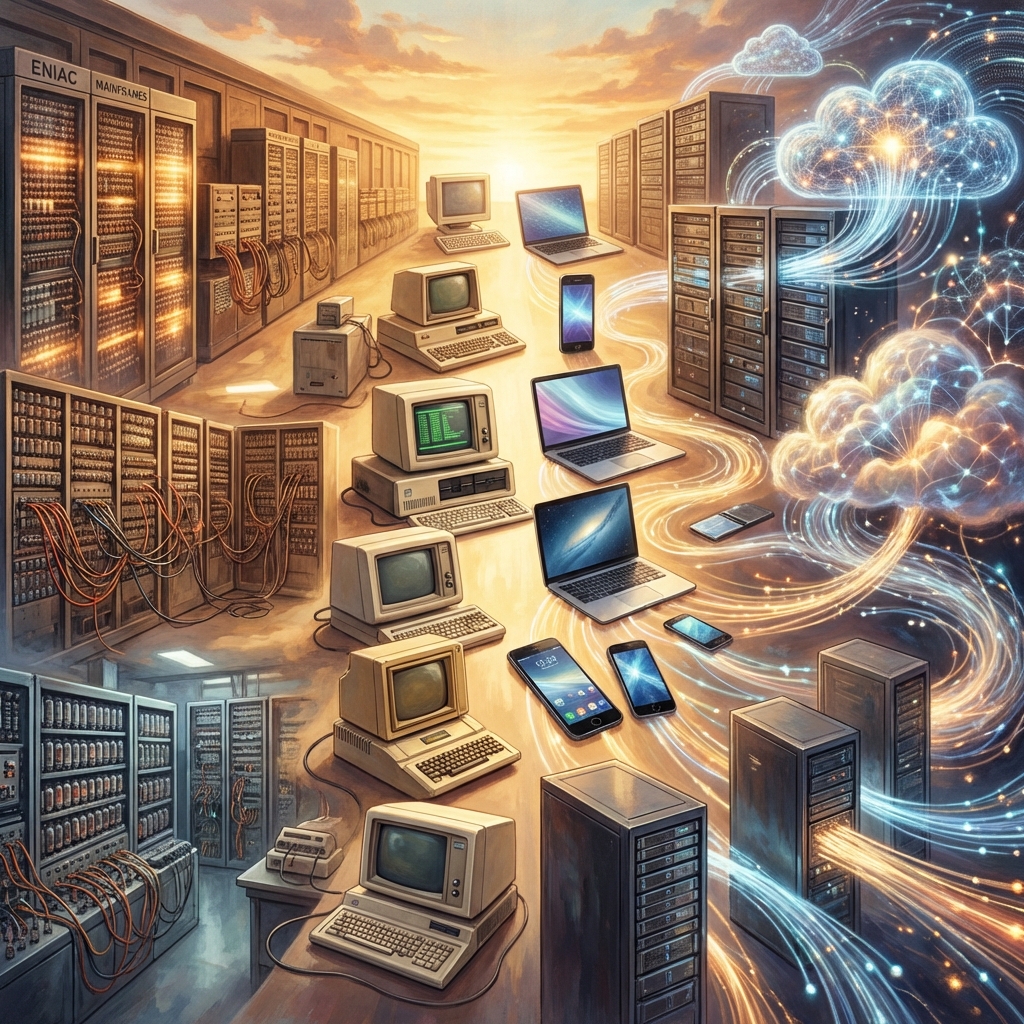
This volume aims to retrace the history of information technology in a crucial period, between 1950 and 2025. This time window has witnessed radical transformations, from the birth of the first electronic calculators, often bulky and with limited calculation capacity, up to the advent of globally interconnected distributed systems, mobile devices with surprising performance and sophisticated artificial intelligence capable of learning and solving complex problems.
Through a rigorous and accurate approach, we will explore the joint evolution of hardware , the physical component of computer systems, and software , the set of programs and instructions that guide their operation. We will analyze the technological innovations that have led to the miniaturization of components, the increase in computing power and the diversification of architectures. In parallel, we will examine the development of programming languages, operating systems, software development methodologies, and application architectures that have made it possible to create increasingly complex and pervasive applications.
Aimed primarily at computer science students, both at upper secondary and university levels, this book aims to provide a complete and detailed overview of the fundamental stages that have shaped modern computing. The goal is not only to describe the emerging technologies in each historical period, but also to explain the underlying scientific and engineering principles, the motivations that guided the design choices and the impact that these innovations have had on the world.
In the following chapters, we will undertake a journey through the different eras of information technology, from the pioneering 50s and 60s, characterized by the birth of mainframes and the first programming languages, up to the current scenario dominated by cloud computing, big data and artificial intelligence, without neglecting the revolutions of the personal computer and the Internet which have profoundly changed our way of living and interacting with technology.
I hope that this book can be a valuable resource for your education and can stimulate your curiosity and passion for the dynamic and fascinating world of information technology.